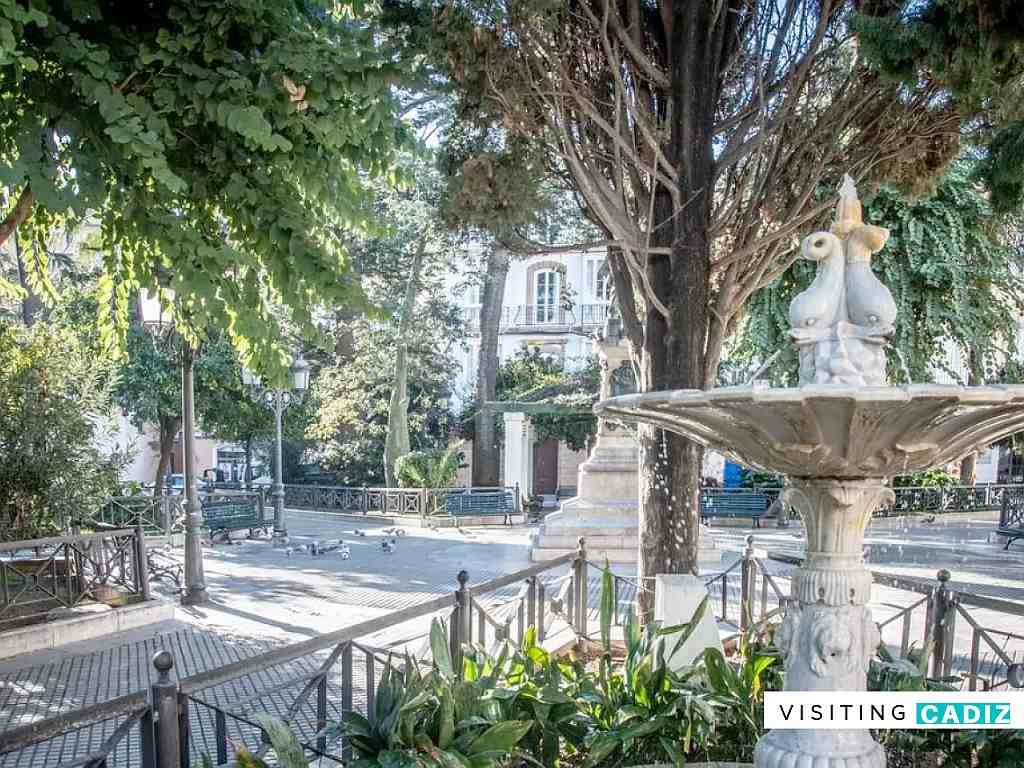
Plaza de Mina is one of the most attractive historic squares in Cádiz, right in the heart of the old town. Its leafy gardens, central fountain and elegant buildings make it a pleasant place to explore, while the surrounding streets are home to several important cultural attractions.
The square is named after General Espoz y Mina, a hero of the War of Independence who donated the land to the city in the late 18th century. Today, Plaza de Mina is particularly known for its gardens, the Fountain of the Four Seasons, the historic buildings around the square and the nearby Museum of Cádiz.

The Audio Guided Tour of Cádiz
The Plaza de Mina is part of the Visit Cádiz audio guided route. Check it out here: https://visitingcadiz.com/immerse-yourself-in-cadizs-rich-history-a-guided-audio-tour/
Or, just scan the QR code on the left with your mobile phone.
Plaza Mina Suites – A great place to stay in Plaza Mina
If you’d like to stay close to Plaza de Mina, Plaza Mina Suites occupies a former merchant’s palace dating from 1888. The suites are a short walk from Genovés Park and around 10 minutes from La Caleta Beach, making it a convenient base for exploring this part of Cádiz on foot.

Check out prices and availability over at booking.com
The Gardens of Plaza de Mina
The gardens are laid out around a central gazebo, with paths radiating out towards a wide promenade around the edge of the square. Trees, flower beds and benches with wrought-iron backs give the plaza a shady, relaxed feel, while the traditional cast-iron lamp posts add to its character.
One of the most distinctive features of Plaza de Mina is its large central fountain, known as the “Fountain of the Four Seasons”. Built in the mid-19th century, it is decorated with four allegorical statues representing spring, summer, autumn and winter.
The outer perimeter of the plaza is made up of four alignments of various species, among which, due to their size and uniqueness, several specimens of Aleppo pine (Pinus halepensis) of approximately 100 years, various specimens of fire tree (Brachychiton acerifolius ), plane trees (Platanus hybrida), tree of heaven (Ailanthus altíssima) or bottle tree (Brachychiton populneus). Likewise, the existing specimens of flamboyán (Delonix regia) stand out for their great beauty when in flower.

Look out for the four statues that represent the seasons.
- Spring is represented by a woman carrying flowers. This is Flora, the Roman goddess of flowers, gardens and spring.
- Summer is also represented by a woman carrying ears of grain. This is Ceres, the Roman goddess of agriculture, crops and fertility.
- Autumn is represented by a young man with vine leaves and a bunch of grapes, representing the grape harvest.
- Winter is represented by an older, bearded and hooded man.

Carved in white marble on a smaller scale than life, they all wear Roman togas or tunics and are displayed on cylindrical pillars.
Notable buildings surround the Plaza de Mina
The buildings surrounding Plaza de Mina reflect the wealth and architectural tastes of Cádiz’s 18th- and 19th-century bourgeoisie. Their façades include Baroque, Neoclassical and Elizabethan influences, giving the square much of its distinctive character.
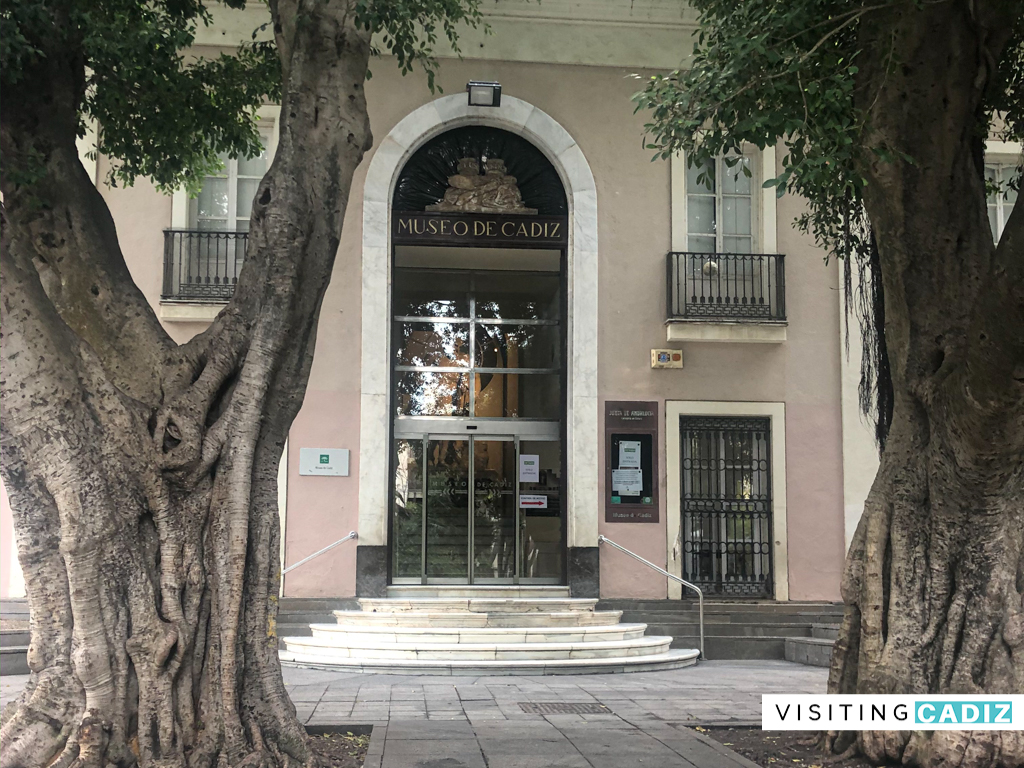
Among the most notable buildings are the Museum of Cádiz and Casa Pinillos, now a cultural centre. Number 3 is also marked with a plaque commemorating the birthplace of Cádiz-born musician and composer Manuel de Falla.
Other notable figures who lived in the surrounding buildings include the geologist José Macpherson and the philanthropist Ana de Viya, who devoted her capital to charity and was the founder of the Salesian Professional School.
A Salesian school is an educational institution run by the Catholic Salesian Congregation of Saint John Bosco (or Don Bosco), and one that uses his methods. Salesian schools are dedicated to helping young people, especially the poor, in an educational and formative environment.
The Museum of Cádiz at Plaza Mina
The Museum of Cádiz was founded in 1970 when the city’s Fine Arts and Archaeology collections were brought together. Today, it offers a fascinating look at Cádiz and the surrounding province through its archaeology, art and traditional puppetry collections.

The art gallery
The art gallery contains an impressive collection of works by artists including Zurbarán, Murillo, Rubens, Zuloaga, Sorolla and Miró.
The archaeology department
The archaeology department contains some outstanding objects, including the famous Phoenician sarcophagi discovered in the port of Cádiz in 1877.
Many other artefacts from the Roman era are available to see from local sites such as Baelo Claudia, Medina Sidonia, Carissa Aurelia, Sancti Petri or Gades (Cádiz) itself.
The collection is split into various categories installed inside 8 display rooms.
La Tía Norica de Cádiz
La Tía Norica de Cádiz, is a puppet show tradition dating back 200 years or more. The latest investigations date its existence to around 1790 and it’s considered to be of Italian origin. The puppets are recognised as works of art and have been awarded the Gold medal for merit in fine arts.
The collection was declared an asset of cultural interest by the Junta de Andalucía and some of the oldest pieces are located here in the Museum of Cádiz.
Plaza de Mina brings together several sides of Cádiz in one square — gardens, historic architecture, local history and one of the city’s most interesting museums. It’s also a pleasant place to slow down for a while, especially if you’re exploring the old town on foot.
See the full list of plazas in the city of Cádiz here: https://visitingcadiz.com/plazas-in-cadiz/
See more parks and gardens in Cádiz here: https://visitingcadiz.com/parks-and-gardens/
Frequently Asked Questions About Plaza de Mina
Plaza de Mina has played an important role in the social and cultural life of Cádiz for centuries. Today, its historic buildings, gardens, monuments and the Museum of Cádiz make it an interesting place to explore while walking through the old town.
The square features the “Fountain of the Four Seasons” with four allegorical statues representing spring, summer, autumn, and winter. Carved in white marble, each figure wears Roman attire, offering a charming mix of art and symbolism. Look closely for Flora, Ceres, a grape-harvesting youth, and a winter figure with a hood and beard.
Plaza de Mina is framed by impressive 18th- and 19th-century bourgeois houses. Noteworthy sites include the Museum of Cádiz and Casa Pinillos, now a cultural centre. Some buildings commemorate famous residents like composer Manuel de Falla or philanthropist Ana de Viya. Each façade showcases Baroque, Neoclassical, or Elizabethan styles.
The Museum of Cádiz contains fine art, archaeology and puppetry collections. Highlights include works by major Spanish and European artists, Phoenician sarcophagi discovered in Cádiz, and the historic La Tía Norica puppets. The collections are spread across three floors of the former Convent of San Francisco.
Yes, Plaza de Mina features a central gazebo, flower beds, radial paths, and benches shaded by trees like Aleppo pines, plane trees, and flamboyán. The gardens’ design encourages leisurely strolls, and seasonal blooms add vibrant colours throughout the year, making it a relaxing stop in Cádiz.
Plaza Mina Suites is one of the closest accommodation options, occupying a former merchant’s palace on the square. It is well placed for exploring Cádiz’s old town on foot, with Genovés Park and La Caleta Beach also within walking distance.

I’ve been living in this lovely area of Western Andalucia for the last 20 years or so and dedicate most of my time to the running of English language tourist information websites for the towns of Cádiz, Ronda, Grazalema, the famous or infamous Caminito del Rey, and also Wildside Holidays, which promotes sustainable and eco-friendly businesses running wildlife and walking holidays in Spain. My articles contain affiliate links that will help you reserve a hotel, bus, train or activity in the area. You don’t pay more, but by using them you do support this website. Thankyou!